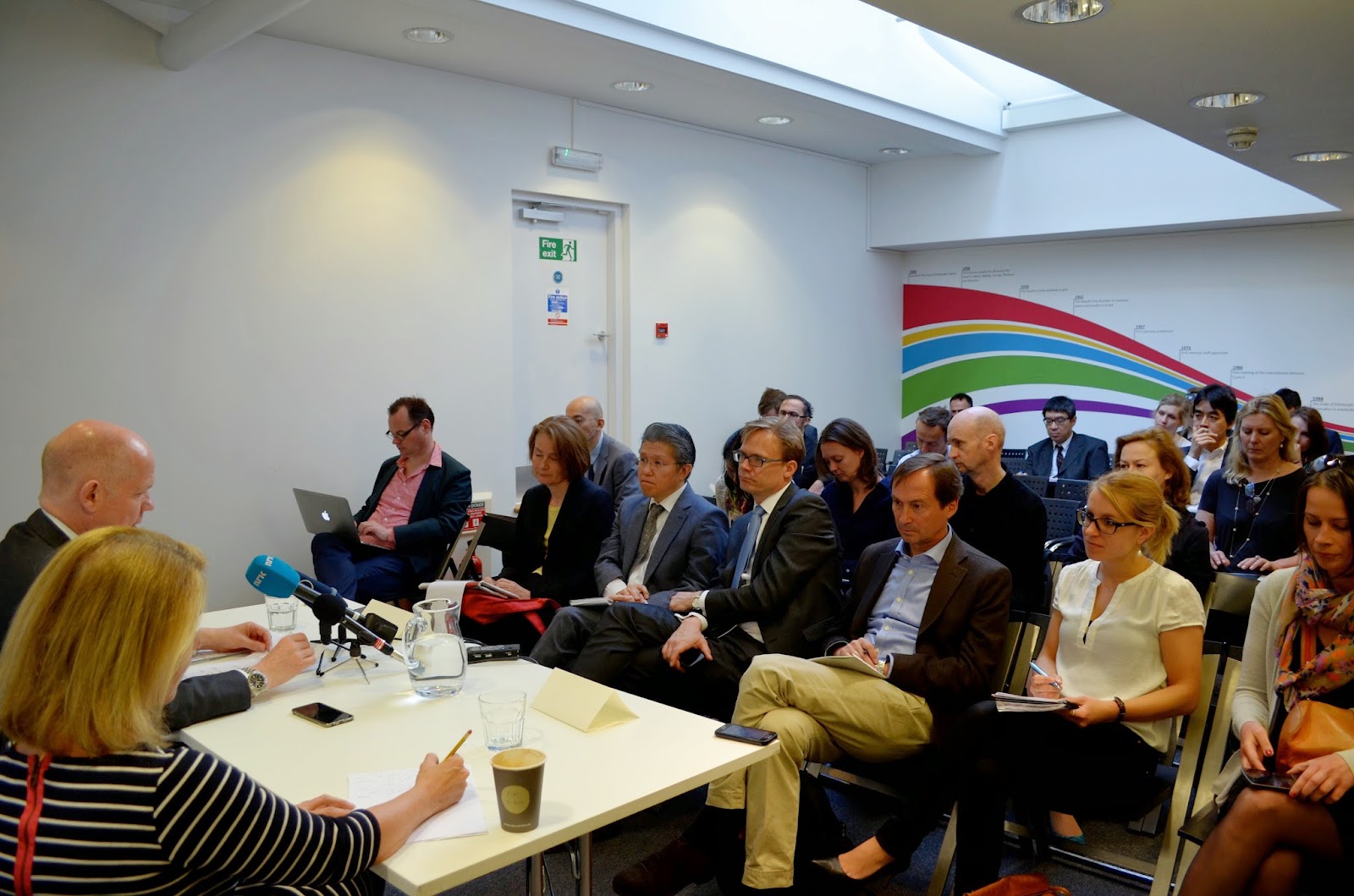
Betting on the outcome of the General Election will be big business for bookies this week, with about £10 million added to industry turnover. Rupert Adams from William Hill told international journalists at the FPA that he expects his company to take in about £2.5 million by Friday. The biggest single bet so far is £200K placed on a hung Parliament at odds on of 2 to 9; the man who placed the bet – the same guy who bet £900K on a No vote in the referendum in Scotland – stands to win £44,440 if he’s proved right. Mr Adams said that if you are looking for value today at the bookies, look at the odds on a Conservative majority Government.
Tuesday, 5 May 2015
Thursday, 30 April 2015
City of London view of the election
![]() |
| Mark Boleat, City of London Corporation. Photo: Policy Exchange/flickr commons |
Britain's financial sector is unlikely to be unsettled by any of the possible outcomes of next week's general election, Mark Boleat, Policy and Resources Chairman of the City of London Corporation, told FPA members.
Boleat said that the City of London Corporation are in contact with all the main political parties and willing to work with whoever wins on May 7th.
“We'll be looking for a government that manages the economy competently.” On Ed Miliband’s credentials as future prime minister, he said: “Only time will tell. He’s had a very good campaign.”
Boleat argued that both the public and UK business were clear that the UK should remain part of the EU, adding that the real debate was confined to within the Tory party. Boleat confidently predicted the UK will remain within the EU, but noted that a Labour victory next week could result in a more eurosceptic Conservative party.
When asked about immigration, Boleat said “there’s a need for a better quality of debate on this.” Business leaders felt this government should not be evicting foreign students when they graduate, he said, just as they reach the point when they can contribute to the economy.
Secondly, he said business often felt constrained by tight immigration restrictions which meant they struggled to bring in expertise from abroad at short notice.
On inequality in Britain, Boleat said “the solution is not to tax everyone heavily it is to help them earn.” He argued that people will always say there is growing inequality even when there isn’t much evidence.
When asked about whether too much power was concentrated in London, Boleat replied: “What is good for London is good for the rest of the country. I know it's tempting to think London sucks resources from the rest of the country – it's not true.”
He pointed out that there are more financial services jobs outside London than inside. “Cities are where the growth is,” he insisted.
He also argued that both Labour's plans to scrap the 'non-dom' tax status and the prospect of Greece leaving the Eurozone would have little impact on the City of London.
Tuesday, 28 April 2015
Chatham House Director on UK foreign policy challenges
UK foreign policy is entering a challenging phase as the country faces a prolonged period of uncertainty over its membership of Europe, combined with a weakening of central power in a multi party system.
That’s the view of Chatham House Director Robin Niblett to an audience of foreign journalists on Tuesday. He thought UK governments would find it much more difficult to lead on foreign policy issues for years to come.
Speaking on the opportunities and challenges facing the next UK government, Dr Niblett said that – regardless of the outcome of the general election – he envisaged that Britain would hold an in-out referendum on its EU membership within the next ten to fifteen years.
If David Cameron's Conservatives hold on to power, the UK will be distracted for two years as the country prepares for a poll in 2017. Under a Cameron government, Dr Niblett predicted there would be a good chance of a 'yes' vote to retain EU membership.
Even if Labour take power, Ed Milliband's rejection of a referendum would not prevent the Labour party having to allow a vote on EU membership further down the line, he predicted.
Dr Niblett partially agreed that the UK's foreign policy had been on the back foot under the current government, citing the diminished importance of the 'special relationship' with the US.
This was partly due to public fatigue and scepticism following military interventions in Afghanistan, Iraq and Libya, but also because austerity had put pressure on defence and diplomatic budgets.
However, Dr Niblett said he believed the UK's Trident nuclear deterrent was safe.
Dr Niblett was keen to put UK foreign policy in a global context, saying Britain was still in the “top rank.” London had retained and built on its status as a hub for international discussion, he said, leading the way on issues such as sexual violence in conflict and tax avoidance.
Despite playing a more cautious role in the world, Dr Niblett outlined three areas where the next UK government would be under considerable pressure to act: the Middle East, Russia and Climate Change.
Dr Niblett said Europe was facing an existential moment of truth about the “tsunami of migrants” heading from the Middle East and Africa.
The UK would have to act decisively on the issue of Russian sanctions in July, when the EU is set to debate whether to continue with them. Dr Niblett said he felt the UK should argue to continue sanctions at their current level as long as Russia upholds the terms of the Minsk II agreement over Ukraine.
What the EU wanted was the rule of law within the EU and its neighbourhood; this was the best way to keep Europe strong. The EU could live with a “frozen conflict” confined to the south east corner of Ukraine, he said.
And he thought the UK would be under pressure play a leading role in the UN Climate Change Conference in Paris this December, particularly on the issue of coal consumption.
Wednesday, 22 April 2015
MORI on the Latest Polling
Sir Robert Worcester, founder of MORI told FPA members that after May 7th his best guess was as follows: a hung Parliament, no coalition, a minority Government lead by Prime Minister Ed Miliband.
Even though the Tories may end up with a few more seats than Labour, it was most likely that a Labour administration could get their priority bills through Parliament with support from the Liberal Democrats and the SNP. He predicted there might well be another General Election a year from now.
He said that his polling had indicated for many months past that banging away on the economy was not going to move votes to the Conservatives. On the role of social media Sir Robert said the evidence was that it helped encourage volunteers and attract funders, but didn't have much effect on the result.
Tuesday, 21 April 2015
Labour calls for mercy for Mediterranean migrants
Labour spokesman on Europe Pat McFadden told FPA members that the Pope had been correct about the risks faced by migrants from North Africa, “We cannot allow the Mediterranean to become a graveyard”. He said Labour was calling for a resumption of funding for the EU Triton search and rescue operation. It wasn’t fair to leave it all to Italy, he said.
Mr McFadden said Labour would resist the forces of nationalism and isolation in this General Election. Britain was flirting with the possibility of leaving the EU because of weak leadership; the Prime Minister had put party management before the national interest.
He said the centre of gravity in today’s Labour Party was pro EU and a Labour Government would be a force for reform in Europe, not a battering ram for Brexit. His colleague Gareth Thomas from the shadow Foreign Office team said the Labour campaign on the ground was going very well and the Labour activist base in the country had been growing since 2010.
Wednesday, 15 April 2015
William Hague: farewell to parliament
William Hague told FPA members the UK faced a crucially important General Election; in his 26 years in Parliament the Conservatives had had to rescue the British economy from Labour not once, but twice. The UK must keep going forward for success, not back to the disastrous policies of the Labour Party.
Mr Hague said he was proud of what the Conservative led Government had achieved with its commitment to overseas aid of 0.7% of GDP – contributing to tackling ebola, to increasing vaccination levels, and to pushing the initiative on preventing sexual violence. Morale in the Conservative party was high, and the campaign was going well so far.
David Cameron, he said, is a brilliant Prime Minister and party leader: he had a strong record of exceeding expectations in European negotiations, and the Conservatives wanted to be able to recommend a yes to staying in the EU in a future referendum following a successful negotiation.
Mr Hague said the two party system had prematurely been pronounced dead many times in the past, but now it seemed the SNP could win a lot of seats from Labour in Scotland, opening up the nightmare scenario of a Labour Government propped up by the SNP.
The great prize of the twenty first century, he said, was full social, economic and political equality between men and women; and if you "thought the Conservative Party was dominated by men, you should meet the Home Secretary – it certainly didn’t feel that way!"
Tuesday, 10 March 2015
Professor Vernon Bogdanor on Britain's stability
| Professor Vernon Bogdanor |
Professor Vernon Bogdanor from King's College London told FPA members however unpredictable the outcome of the General Election, Britain was much less unstable than many countries. There's no far right or far left political parties and no great economic instability. It was important to retain a sense of perspective.
The EU had caused nothing but problems for all Prime Ministers since the 1950's and currently it was immigration at the top of the agenda. There will be no Treaty changes and David Cameron, he said, was raising expectations about renegotiation which he could not meet.
One scenario after May the 8th was the SNP supporting a minority Labour Government which they would not wish to destabilise before the Scottish Elections in Spring 2016. Professor Bogdanor said the current electoral system exacerbated and exaggerated the differences that increased the pressure for Scottish separation from the United Kingdom.
| A full house at FPA this morning |
The politics of ideology was being replaced by the politics of identity. The question was no longer capitalism or socialism, it was, what is British? Can you be British and Scottish? Can you be British and European?
In a globalized economy people with low skills were losing out and felt left out by the main political parties; hence the rise of UKIP and the Greens. UKIP was the first popular insurgent mass movement since the Second World War, he said.
Professor Bogdanor said he was personally in favour of electoral reform with the introduction of the Single Transferable Vote; in favour of a written constitution; and in favour of lowering the voting age to sixteen. It might help young people pick up the habit of voting.
Subscribe to:
Posts (Atom)